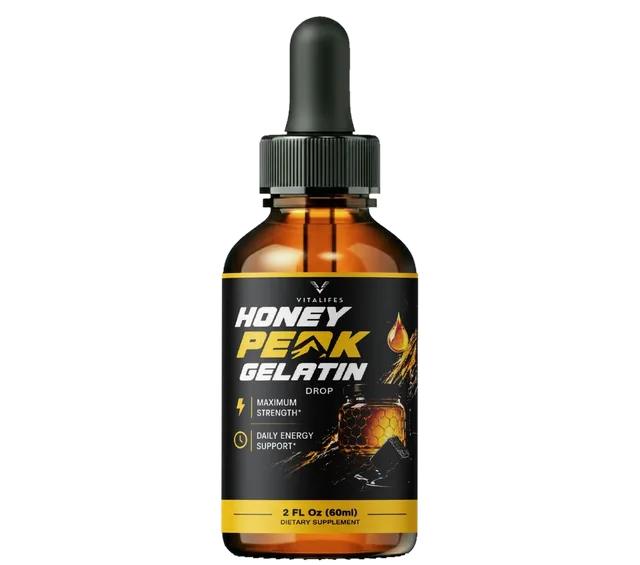
Honey Peak Gelatin Drops for Men: Herbal Liquid for Daily Energy Support
60 ml · 30 servings of 2 ml
1 ml twice daily30 servings a bottle
121 mgone blend, six parts
Quick answer
Honey Peak Gelatin is an herbal liquid supplement, taken as drops for men's daily energy support. It is also searched as HoneyPeakGelatin, the same product. The bottle reads Maximum Strength and Daily Energy Support. One 121 mg blend holds six botanicals: gotu kola, Chinese hawthorn, horse chestnut, motherwort, butcher's broom and grape seed. Shake well and take 1 ml twice a day by dropper. A 60 ml bottle holds 30 servings of 2 ml, about one month. It is a liquid, not a gummy or capsule. It is meant for adult men; anyone on medication should ask a doctor first. Bottles come from an FDA-registered facility with GMP certification and ship sealed from the United States. Packs of one, three or six bottles are sold by Thehoneypeakgelatin, the U.S. stocking partner. Dr. Mohit Khera, MD reviewed this page.
What is Honey Peak Gelatin? The herbal drops explained in 60 seconds
Honey Peak Gelatin is a liquid herbal dietary supplement, taken as drops for daily energy support. You take 1 ml twice daily from a 60 ml bottle of thirty 2 ml servings. The label prints one 121 mg blend of six botanicals, and no honey or gelatin.
Honey Peak Gelatin is a liquid herbal supplement sold by Thehoneypeakgelatin, the U.S. stocking partner for Honey Peak Gelatin. One 60 ml dropper bottle holds thirty 2 ml servings, taken as 1 ml twice daily. The bottle claims Maximum Strength and Daily Energy Support, and the marketing is built around men's performance. The Supplement Facts panel prints a single 121 mg proprietary blend of six ingredients — gotu kola, Chinese hawthorn, horse chestnut, motherwort, butcher's broom and grape seed — with not one individual amount. There is no honey and no gelatin in it. Prices show at the seller's checkout.
One point surprises most first-time readers: despite its name, the label lists no honey and no gelatin. The sweetness comes from sucralose and the base is water and vegetable glycerin, as the Supplement Facts panel and the other-ingredients line show on the label page.
The second point is about the herbs. The label claims daily energy support, and its six botanicals are best known from research on circulation, veins and the heart. The section on five label points worth knowing sets this out, including one caution for anyone with diabetes.
Honey Peak Gelatin drops: what the name means, and what the label lists
The name is a brand name, not an ingredient list. The label shows no honey and no gelatin; it lists six botanical extracts in one 121 mg blend, with sucralose as the sweetener in a water and vegetable glycerin base.
The brand’s performance panel. The bottle in the photograph claims Maximum Strength and Daily Energy Support; the panel on its back lists six vein and heart herbs.
Read the panel, not the name
A product name is a trademark. It is the least regulated element on a supplement bottle: claims need substantiation and a disclaimer, and the Supplement Facts panel has a prescribed format down to the order of its lines. A name needs none of that, and nothing requires it to match what is inside.
Honey Peak Gelatin uses two ingredient words. Honey is not on this label anywhere. Gelatin is not either, and could not be — gelatin is a capsule shell or a gelling agent, and this is a liquid in a dropper bottle. The sweetness in it comes from sucralose, an artificial sweetener on the other-ingredients line.
The brand panels speak of performance; the six herbs underneath, gotu kola, hawthorn, horse chestnut, motherwort, butcher's broom and grape seed, are studied at Memorial Sloan Kettering and NCCIH mainly for veins and the heart. The ingredients page takes all six in order.
Looking for a testosterone or pre-workout product?
Honey Peak Gelatin is neither. None of the six herbs is listed in our sources for testosterone, strength or stimulant use, and motherwort is traditionally a calming herb. The label claim is daily energy support, and the drops contain no caffeine.
How the Honey Peak Gelatin 121 mg blend is shared
Six ingredients share one 121 mg blend per 2 ml serving, listed by descending weight, so gotu kola is the largest share and grape seed the smallest. The label gives no single amount, which is about 20 mg each if split evenly.
This is the whole formula. One line on the Supplement Facts panel, one total, six ingredients underneath it. Below, that line is drawn as a graphic with its caveat printed on it: the segments show the six names, not measured amounts.
121 mgone proprietary blend · 6 ingredients · not one individual amount published
Gotu Kola Extract — listed first, so the largest shareGrape Seed Extract — listed last, so the smallest
The segments above are drawn equal because nobody has published the real split. They are not a measurement. US labelling rules require a proprietary blend to list its ingredients by descending weight, so we know the order and the 121 mg total — and nothing else. One ingredient could be 100 mg and the other five a trace, and this label would look exactly the same.
The Supplement Facts panel on the back of the bottle: serving size 2 ml, thirty servings, one Proprietary Blend line at 121 mg, six names underneath it and a daily value column marked not established.
What “Maximum Strength” means on a 121 mg label
Here is the figure in context. A 2 ml serving of this product carries 121 milligrams of blended botanical extract in total. Divided six ways, that is an average of about 20 mg per ingredient.
For comparison: horse chestnut vein trials use 300-600 mg a day. Butcher's broom trials use 150-300 mg. Hawthorn trials run from 160 mg up to 1800 mg. Every one of those is larger than the entire blend in this bottle, and in hawthorn's case by up to fifteen times.
Extracts can be concentrated, which matters. No extract ratio is published for any of the six, though, so the label alone cannot show how close a serving comes to a study dose. The full label page reproduces every line of the panel.
Honey Peak Gelatin label points: what it prints, and what it leaves out
Five label points matter before you buy: the name is not an ingredient list, the six herbs are circulation and heart herbs, the same panel appears elsewhere, Maximum Strength sits over a 121 mg blend, and butcher's broom carries a diabetes caution.
Five points on this label are worth knowing before you buy. Each is a fact you can check on the bottle or in a cited source; none is a recall or a defect.
01
The name is a brand name, not an ingredient list
Honey and gelatin are both in the name and neither is on the label. The Supplement Facts panel lists six botanical extracts, and the other ingredients are RO water, vegetable glycerin, natural flavor, sodium benzoate, potassium sorbate, malic acid and sucralose.
02
The six herbs are circulation and heart herbs
The brand panels speak to men’s performance, and the bottle claims Maximum Strength and Daily Energy Support. The six ingredients — gotu kola, hawthorn, horse chestnut, motherwort, butcher’s broom, grape seed — are studied mainly for veins, circulation and the heart rather than for energy or strength.
03
The same six-herb panel appears on another product
The seller packs this desk holds show the same 121 mg blend, the same six ingredients and the same other-ingredients line on a product sold under a different name for a different purpose. It suggests the formula was not built around the energy claim on this front label.
04
“Maximum Strength” over a 121 mg blend
The front of the bottle says Maximum Strength. The panel says the entire active content of a serving is 121 milligrams, shared between six extracts — about twenty milligrams each. Four of the six are studied at doses larger than the whole blend. Maximum relative to what is not stated, and there is no second strength of this product to compare it to.
05
Butcher’s broom: a caution for people with diabetes
Memorial Sloan Kettering’s butcher’s broom monograph carries an explicit Do Not Take line: “You have diabetes (butcher’s broom was reported to cause diabetic ketoacidosis…)”. Butcher’s broom is on this panel and the bottle does not mention it, so ask your doctor first if you have diabetes.
What to do with these points
Read them next to the bottle. If the fifth applies to you, or you take heart or blood-pressure medicine, talk to your doctor before the first dose; the safety page has the detail with sources.
Honey Peak Gelatin product information: form, dose, size and terms
Honey Peak Gelatin is a liquid taken by dropper, 1 ml twice daily. A 2 fl oz (60 ml) bottle holds 30 servings of 2 ml, the blend is 121 mg, and the price is shown at the seller's checkout.
Everything in this table came from the bottle photographs or the seller pack we were given. Where a fact was not published, the table says so instead of guessing.
Honey Peak Gelatin specification, read from the bottle and the seller pack.
Detail
What the bottle and seller show
Product name
Honey Peak Gelatin, printed on the bottle as HONEY PEAK GELATIN DROP
Front-of-bottle claims
Maximum Strength · Daily Energy Support
Contains honey?
No. Honey appears nowhere on the label
Contains gelatin?
No. It is a liquid; there is no capsule shell and no gelling agent
Form
Liquid drops, taken by dropper
Bottle size
2 fl oz / 60 ml
Serving size
2 ml, taken as 1 ml twice daily
Servings per container
30, so one bottle is thirty days
Blend name on the panel
Proprietary Blend
Blend total
121 mg per 2 ml serving
Named on the panel
Gotu Kola Extract (leaf), Chinese Hawthorn Extract (fruit), Horse Chestnut Extract, Motherwort Extract, Butcher’s Broom Extract (root), Grape Seed Extract
What those six are
Vein and heart herbs, studied mainly for circulation
Ingredient amounts
Not published. Six ingredients, one blend total, no individual figures
Price at checkout. The seller pack routes pricing to the listing checkout
Returns
Procedure supplied; window length not published, see the listing
Best before
12/2028
Lot / certificate
HON-26/TH-2540 / HON-2540-26-TH — reference codes; the lab report is not published
Customer rating
Not shown on this site; the reviews page explains why
Market
United States
The brand’s “formula for men’s needs” panel. Read it against the table above: the panel is a promise about a category, and the table is what was actually supplied to this desk about the product.
Honey Peak Gelatin ingredients list, in panel order
The Honey Peak Gelatin ingredients list reads gotu kola, Chinese hawthorn, horse chestnut, motherwort, butcher's broom and grape seed. They are listed by descending weight, and all six are better known as vein or heart herbs.
Descending order of weight is the panel's own ordering, so the first card below is the largest share of the blend and the last is the smallest. All six are vein or heart herbs. Each card links to the full write-up, with the citation we actually read.
The brand’s ingredients listing panel. Compare what it emphasises against the six names on the Supplement Facts panel.
What the research on these six is actually about
Horse chestnut and butcher's broom both have clinical trials behind them, and what those trials measured was chronic venous insufficiency — leg heaviness, ankle swelling, the symptoms of poor venous return. Gotu kola has a smaller file pointing the same way. Hawthorn's research is cardiac: heart failure and blood pressure. Grape seed's is cholesterol and blood pressure.
Those are real research files. Three of them are better than most supplement formulas can claim. They are not research about strength, stamina, testosterone or energy.
One ingredient — motherwort — has no monograph at NIH, NCCIH or MSK at all, so nothing about it can be checked. Traditionally it is used for palpitations and anxiety, which is worth knowing if you take sleep or anxiety medicine.
Honey Peak Gelatin dose next to the amounts used in research
The label gives one 121 mg total for all six herbs and no single amount. Four of the six are studied at daily doses larger than the whole blend, so the label alone cannot show how close a serving comes to a study dose.
This table sets the daily amounts used in research beside what the label tells you. The middle column reads the same in every row, because the label gives one total for all six; the right-hand column explains each comparison.
Researched intakes against what Honey Peak Gelatin publishes.
Ingredient
Amount here
Typical amount in research
What that comparison is worth
Gotu Kola Extract
Not published
60-180 mg a day
Studied for veins and wound healing, not energy. Possible within 121 mg only if it takes most of the blend.
Chinese Hawthorn Extract
Not published
160-1800 mg a day
A heart-failure research file, not a performance one. The upper trial dose is fifteen times the whole blend.
Horse Chestnut Extract
Not published
300-600 mg a day
Studied for leg veins. A trial dose is two to five times the whole blend, and no aescin figure is published.
Motherwort Extract
Not published
No dose could be sourced
No NIH, NCCIH or MSK monograph exists. Traditionally a calming herb.
Butcher’s Broom Extract
Not published
150-300 mg a day
Studied for veins. Also the ingredient MSK tells people with diabetes to avoid.
Grape Seed Extract
Not published
100-300 mg a day
Studied for cholesterol and blood pressure. Listed last, so the smallest share of the 121 mg.
What the numbers mean
A serving delivers 121 mg of blended material in total, and the front of the bottle calls that Maximum Strength. Four of the six ingredients on this label are studied at doses larger than the entire blend. That is not an accusation against this product; it is true of a great many multi-botanical liquids. It is a reason to keep expectations modest and to ignore anyone promising otherwise.
How to take Honey Peak Gelatin drops: 2 ml a day in two doses
Shake the bottle well, then take 1 ml twice daily by the dropper markings, or as directed by your healthcare provider. That makes the 2 ml serving, so one 60 ml bottle lasts thirty days.
Seven steps, all of them drawn from the directions on the bottle or from the cautions in the sources we cite. Nothing here is invented, and where the label is silent we say that it is rather than choosing for you.
Shake the bottle before every dose
This is the first word of the label’s own instruction and it is not decoration. A botanical extract suspended in water and glycerin separates as it stands. A bottle that is not shaken delivers a different concentration at the start of the month than at the end, and you will have no way of knowing which.
Take 1 ml twice daily, using the dropper markings
The full instruction reads: “Shake bottle well. Take 1ml twice daily or as directed by your healthcare provider.” The dropper is the measuring device; a squeeze is not a unit. Two doses of 1 ml make the 2 ml serving the panel is built around, which is what makes a 60 ml bottle last thirty days.
Check the safety seal before the first dose
The label's caution opens with it: “Do not use if safety seal is broken.” On a liquid this matters more than on a capsule, because a compromised seal on a water-based product is a contamination question rather than just a tampering one.
Talk to your doctor first if any medicine or condition is involved
The label says this itself: “Check with your doctor before using this product if you are using medication or have any medical conditions.” On this formula that line is doing real work — there are four named interactions on the safety page, and one of them concerns diabetes.
Pick two fixed times and keep them
The label does not name times of day, so this is your choice. Morning and evening, attached to meals you never skip, is the pattern most people manage. Consistency matters more than the hour, because the only way to judge a supplement with no published amounts is to hold everything else steady.
Store it cool, dry and out of the light
The label says: “Store in a cool, dry place.” Amber glass is there to keep light out, which tells you the contents are light-sensitive. A kitchen cupboard away from the hob is good; a windowsill and a gym bag in a hot car are the two worst places for it.
Judge it over a full bottle, and write down what you notice
No timeline can be promised for this product, because no amounts are published to base one on. Thirty days is one bottle and one clean test. If you are testing it for training energy, note the boring things — session quality, how you feel at rep eight, sleep — and decide at the end of the bottle whether it earns a second one.
The brand’s how-it-works listing panel. The bottle's own directions are the seven steps above; this panel is marketing and is reproduced here so you can compare the two.
The full how-to-use page covers what to do about a missed dose, whether to take it with food, why the dropper markings matter more on a liquid than people expect, and why we will not print a “results by week four” chart.
Before your first Honey Peak Gelatin order: safety check
Speak to your doctor first if you take nitrates or blood-pressure drugs, have heart failure or an irregular heartbeat, have diabetes, or take a blood thinner. Do not use a bottle whose safety seal is broken.
Two short lists. If anything in the first applies to you, speak to your doctor before the first 1 ml; the second covers the label and the paperwork.
Doctor first
An erection problem that is new, or tiredness that has lasted weeks: either can point to a heart, blood-vessel or other condition (MedlinePlus).
Nitrates such as nitroglycerin, or any blood-pressure medicine: ask before the first dose (FDA).
Heart failure, an irregular heartbeat or digoxin: hawthorn can interact with heart medicine (NCCIH).
Diabetes: Memorial Sloan Kettering advises against butcher’s broom, the fifth ingredient here.
A blood thinner, an antiplatelet or surgery booked: three of the six herbs carry bleeding cautions (NCCIH).
Then check
The dose is 1 ml twice a day by the dropper markings, and the label gives no higher amount.
No honey or sugar is listed. Sucralose sweetens the drops, and no calorie line is printed.
Read the return window on the listing at checkout before you choose a pack size.
Do not use a bottle whose safety seal is broken.
Keep the order email. The order desk asks for its order ID first.
Honey Peak Gelatin Side Effects: four questions for your doctor
The cautions come from the herbs. Memorial Sloan Kettering advises people with diabetes not to take butcher's broom, hawthorn can interact with heart drugs such as digoxin, and three herbs carry bleeding flags. Ask your doctor before the first dose.
Four of the six herbs carry cautions specific enough to name here. The bottle covers them in general terms, asking anyone on medication or with a medical condition to check with a doctor first; the exact wording from each source is on the safety page.
If you have diabetes
Memorial Sloan Kettering's butcher's broom monograph carries an explicit Do Not Take line: “You have diabetes (butcher's broom was reported to cause diabetic ketoacidosis…)”. The case cited is a 39-year-old woman five days after taking it for mild ankle swelling. Butcher's broom is on this panel.
If you take a blood thinner or antiplatelet
Three of the six ingredients carry a bleeding flag. MSK says not to take hawthorn if you are taking antiplatelets or anticoagulants; it warns that horse chestnut products containing aesculin may increase bleeding risk with warfarin or aspirin; and it advises talking to a provider about grape seed because it “may increase your risk of bleeding”. Three flags in one bottle is worth a conversation, and so is mentioning it before surgery or dental work.
If you have a heart condition
Hawthorn's entire research file is cardiac, and MSK flags a potential digoxin interaction. NCCIH separately warns that some products sold as hawthorn have been found to contain toxic yellow oleander, which “may cause severe harm or even be fatal”, and that no study has tested hawthorn beyond 16 weeks.
If you want to know how horse chestnut is processed
MSK states plainly that “horse chestnut seeds are toxic, and can cause major stomach irritation, vomiting, muscle twitching, incoordination, redness, facial swelling, and other serious conditions”. Properly processed extracts remove the toxic fraction. No processing, standardisation or aescin figure is published for this product, so ask the seller before you rely on it.
The label's own caution line reads: “Do not use if safety seal is broken. Check with your doctor before using this product if you are using medication or have any medical conditions.” It also carries the three lines every US supplement bottle carries: keep out of reach of children, do not use if the safety seal is damaged or missing, store in a cool dry place.
Honey Peak Gelatin price and packs: one, three or six bottles
Honey Peak Gelatin comes in packs of one, three or six 60 ml bottles, giving 30, 90 or 180 servings. This site prints no prices, because the live price is shown at the seller's checkout.
Three packs, and no prices printed on this site, because we were not given a price list — the seller's checkout is where the live number lives. What we can tell you is how much product each pack contains and how long it lasts at the one serving the label gives.
Honey Peak Gelatin photographed beside gym equipment — the staging the brand chose, and the reason most people arrive at this page.
What the photograph is doing
The gym setting is the brand’s styling: it shows who the drops are marketed to.
The label itself claims daily energy support, not training results, and the six herbs are vein and heart herbs.
Try it60 ml · 30 servings
1 bottle
60 ml in total · 30 servings · 30 days at 1 ml twice daily, the only serving the label gives
Pack size1 of 6 bottles
Price at checkoutHoney Peak Gelatin is sold through the seller's checkout, so the live price is shown there.
Every pack: ships from the United States · sealed bottles · Listing return terms · returns to 40 West 57th Street, Floor 20, New York, NY 10019, USA
For a first order, the single bottle keeps the amount at risk smallest, and the three-bottle pack gives a fuller trial at the label serving. Read the return window on the listing at checkout before you choose. The pricing page has a cost-per-day sum you can finish once you can see the checkout price.
Honey Peak Gelatin reviews and complaints: our label score
The desk scores Honey Peak Gelatin 1.8 out of 5 across six rows, from label transparency to seller transparency. It is a reading of the label, not a safety finding: ingredient evidence and claim accuracy score low, and seller transparency scores four.
The desk scores every product it covers on the same six rows and publishes the result. Three of the six ingredients have real clinical research behind them, more than many formulas can claim; that research is about veins and the heart rather than the energy the label names, which is why the evidence row scores low.
Label transparencyAre the amounts published?
Ingredient evidenceDo the named ingredients support the use case?
Claim accuracyDo the name and marketing match the panel?
Buying termsPrice, returns and delivery, published clearly?
Safety informationAre the cautions specific and findable?
Seller transparencyWho sells it, from where, contactable how?
1.8 / 5Averaged across six rows, rounded to one decimal place
The brand’s “powerful formula made for men” panel. Our score is not a judgement on the botanicals so much as on the distance between them and the marketing.
One out of five on ingredient evidence, which is lower than we gave the same six herbs on another product this desk covers — because this row asks whether the ingredients support this product's use case, and for strength and energy they do not. One on claim accuracy, because a name containing two absent ingredients, over marketing about male performance, over a panel of vein herbs, is not a rounding error. Four on seller transparency, because a named company, a working phone number, a street address and a returns address is more than most pages in this category manage.
The total, 1.8 out of 5, is a reading of the label, not a safety finding: it says the outside of the bottle tells you less than the panel does. The full scoring page explains each row, and the sources and review page sets out the method.
Honey Peak Gelatin FAQ: ingredients, side effects, price and where to buy
These answers cover what Honey Peak Gelatin is, whether it has honey or gelatin, how to take the drops, side effects, price, returns and where to buy. Each answer comes from the bottle label and the seller pack.
What is Honey Peak Gelatin?
Honey Peak Gelatin is an herbal liquid dietary supplement for men, taken by dropper for daily energy support. A 60 ml bottle holds thirty 2 ml servings, and each serving prints one 121 mg proprietary blend of six botanical extracts. The bottle claims Maximum Strength and Daily Energy Support.
Does Honey Peak Gelatin contain honey or gelatin?
No. Neither word appears on the Supplement Facts panel or the other-ingredients line. Gelatin is a capsule shell or gelling agent, and this is a liquid. The base is RO water and vegetable glycerin, sweetened with sucralose, an artificial sweetener.
What are the Honey Peak Gelatin ingredients?
Six botanical extracts share one 121 mg blend: gotu kola, Chinese hawthorn, horse chestnut, motherwort, butcher's broom and grape seed. Gotu kola is the largest share and grape seed the smallest. The base adds natural flavor, preservatives, malic acid and sucralose.
How should I use Honey Peak Gelatin drops?
Shake the bottle well, then take 1 ml twice daily, or as your own care provider directs. That is 2 ml a day, the panel serving size, so one 60 ml bottle lasts thirty days. The label gives no higher amount, so stay at 2 ml a day.
Does Honey Peak Gelatin have side effects?
The cautions come from the ingredients. Memorial Sloan Kettering lists a Do Not Take line on butcher's broom for people with diabetes, and hawthorn can interact with heart medication. Stay at 2 ml a day, and ask your doctor before the first dose if you take any medication.
Is Honey Peak Gelatin FDA approved?
No. No dietary supplement is FDA approved before sale, and Honey Peak Gelatin is a dietary supplement. The label statements have not been evaluated by the FDA, and the FDA-registered facility seal describes the factory, not the product.
Can I take Honey Peak Gelatin with medication or if I have diabetes?
Ask your doctor first. Butcher's broom carries a Do Not Take line for people with diabetes, hawthorn can interact with heart medicine such as digoxin, and three of the six herbs carry bleeding flags. Mention nitrates, blood-pressure drugs and blood thinners before the first dose.
Where can I buy Honey Peak Gelatin drops, and what do they cost?
Use the Order Honey Peak Gelatin button on this site. It is sold by Thehoneypeakgelatin, the U.S. stocking partner. This site prints no price, because the live price and return terms are shown on the seller's checkout screen.
Is there a money-back guarantee for Honey Peak Gelatin?
A money-back satisfaction seal appears on the artwork, but no window length was supplied to this site. The procedure is to post the bottles to the returns address with your full name, email and order ID. The buyer pays return shipping, and the refund follows 3-5 business days after the return is credited.
What do Honey Peak Gelatin reviews and complaints show?
This site does not publish customer reviews. The review figures supplied with this product repeat, star for star and word for word, across other products from the same supplier. The desk's own label score of 1.8 out of 5 is shown instead, labeled as its view.
Is Honey Peak Gelatin legit?
Yes, it is a real dietary supplement, and its full Supplement Facts panel is published on this site. It comes from an FDA-registered facility with GMP certification and ships sealed from the United States. Returns go to the listed address with your order ID, and refunds follow 3-5 business days after the return is credited.
Does Honey Peak Gelatin work?
No timeline or result can be promised. No ingredient amount is published and no verified customer feedback exists, so judge it over a full bottle, which is thirty days. The six herbs are studied mainly for veins and the heart, not for energy.
Does Honey Peak Gelatin come as gummies, capsules or drops?
Drops only. Honey Peak Gelatin is an herbal liquid in a 60 ml amber dropper bottle, with no gummy, capsule or tablet version sold here. Shake the bottle well and take 1 ml twice daily, which is one 2 ml serving a day.
How many days does one Honey Peak Gelatin bottle last?
One 60 ml bottle holds thirty 2 ml servings, so at 1 ml twice daily it lasts thirty days. The label gives no higher amount, so a bottle is a month of use at the printed dose.
Is Honey Peak Gelatin for men?
Yes. Honey Peak Gelatin is marketed for men's performance, and the bottle claims Daily Energy Support. It is an herbal liquid, not a testosterone booster. Men who take heart or blood-pressure medicine should ask a doctor before the first dose.
How many mg is in Honey Peak Gelatin?
Each 2 ml serving holds one 121 mg proprietary blend of six botanical extracts. The label gives the blend total, not a split by herb. Gotu kola is the largest share and grape seed the smallest.
Is HoneyPeakGelatin the same as Honey Peak Gelatin, and where is the official order page?
Yes, HoneyPeakGelatin as one word and Honey Peak Gelatin with spaces are the same herbal drops. This is thehoneypeakgelatin.com, run by the U.S. stocking partner. The Order button goes to the seller checkout, where the live price and return terms are shown.
Honey Peak Gelatin reading list: guides and blog posts
Six longer pieces from this desk cover men's performance supplements, what a supplement's name may say, why millilitres are not milligrams, and why no star rating appears here. Each was written from the label and medically reviewed.
Six longer pieces from this desk, each written from the label and medically reviewed before publication.
Read the Honey Peak Gelatin label, then order from the official website
Honey Peak Gelatin is sold by Thehoneypeakgelatin, the U.S. stocking partner. A 60 ml dropper bottle holds thirty servings of one 121 mg blend of six botanicals, and the seller's checkout shows the live price and return terms.
A 60 ml dropper bottle, thirty servings and one 121 mg blend of six botanicals, taken as 1 ml twice a day. The live price and the return terms are both shown on the seller’s checkout screen.
Listing return terms · Questions first? Start at the contact page
Start here: Honey Peak Gelatin label, ingredients and safety
Three pages cover the essentials: the label line by line, all six ingredients with their research, and safety and interactions for diabetes, blood thinners and heart drugs. Start with the label, then read the safety page before the first dose.
Who wrote and checked this Honey Peak Gelatin page
The Honey Peak Gelatin Editorial Desk wrote this page from the bottle photographs, the seller pack and linked sources. Dr. Mohit Khera, MD, a physician, reviewed it before publication. It is general information, not advice about your own health.
This page was written from the bottle photographs, the seller pack and the sources it links, then medically reviewed before publication. It is general information, not advice about your own health.
Erection or energy problems that are new, or any nitrate, heart or blood-pressure prescription, call for a doctor's visit before you try Honey Peak Gelatin.